Featured investigation / July 2, 2026

Rent freeze becomes reality, now what?

Compare competing coverage of NYC rent-freeze policy, then test building-level cash-flow assumptions with an interactive model.

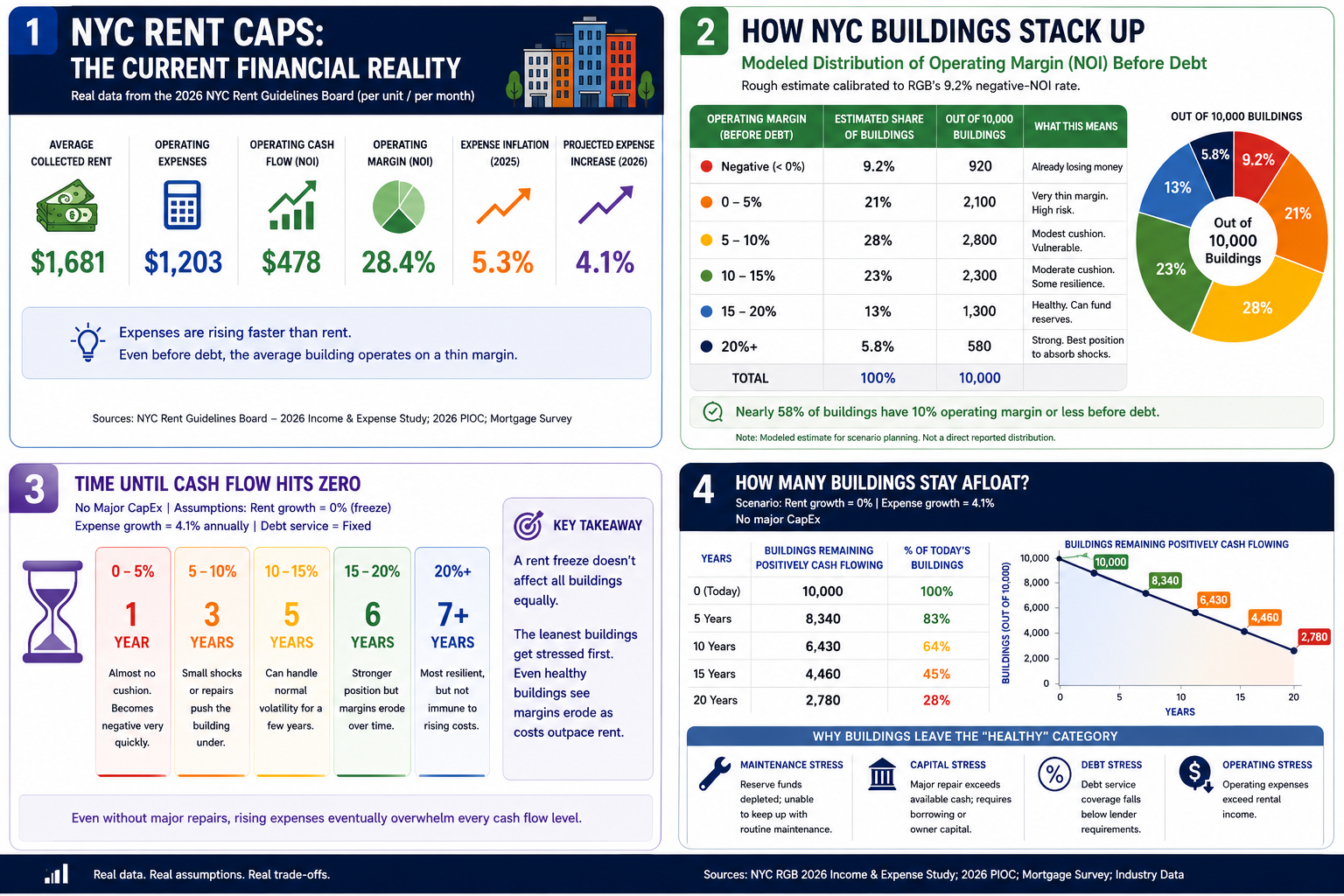
Infographic showing modeled impacts of a New York City rent freeze on building operating margins and cash flow.

Original research visual

Open the calculator scenario

Question

Does the math support the claim?

Claim being tested

Rent freezing could render about 36% of buildings in NYC financially unsustainable in 10 years or less, and that is if inflation is at 4% with no major expenses. Given costs, insurance, and utilities increasing by more than 4%, the losses could be greater and faster.

The claim is realistic under the stated assumptions. The measured baseline starts with about $1,681 in collected rent and $1,203 in operating expenses per unit per month, leaving $478 before debt service, reserves, and major repairs. If rent growth is frozen at 0% while operating expenses rise about 4.1% annually, that operating cushion erodes quickly even before adding financing stress or major capital repairs.
Fact-based response

Why the numbers are plausible

The starting operating margin is roughly 28.4%, calculated as $478 divided by $1,681.

With rent held flat and expenses growing at 4.1% per year, operating expenses rise from about $1,203 to about $1,798 per unit per month by year 10.

That turns the average starting operating cash flow from about +$478 per month into about -$117 per month by year 10 before debt service or CapEx reserves.

Buildings that start with smaller operating cushions would fail sooner than the average building. That makes the idea that roughly one-third of the pool could become financially unsustainable within 10 years a realistic modeled outcome under these favorable assumptions.

Adding debt service, insurance shocks, taxes, utilities, or major repairs makes the stress larger and faster.