Research investigation / November 11, 2026

Texas SB 297: Who Would Qualify for a $1,500 Check?

A plain-language guide to proposed household eligibility, citizenship questions, roommates, homeless residents, and a potential funding shortfall.

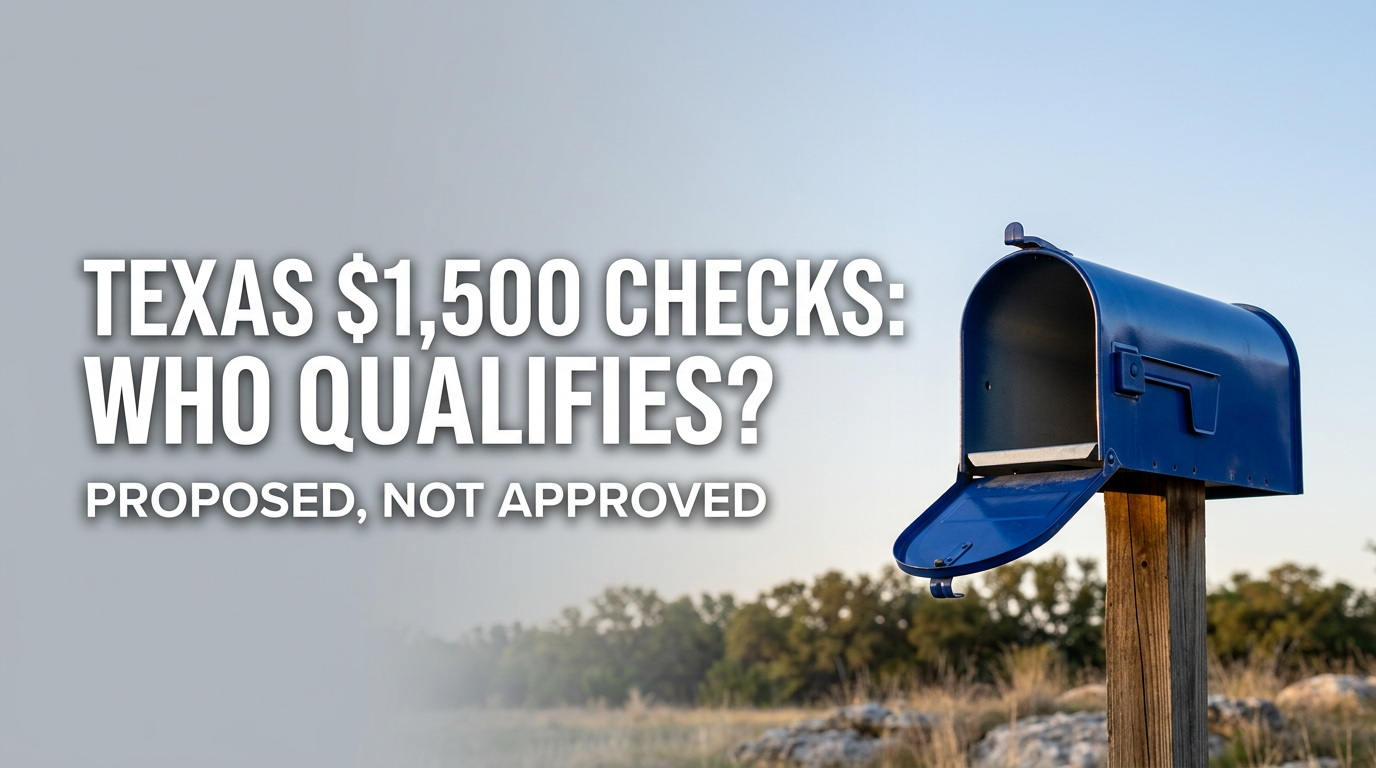
Texas map with proposed $1,500 payment and prominent not-approved warning.

Average-American.net SB 297 editorial graphic

Read the research

Question

Who qualifies for Texas's proposed $1,500 payment, and who does not?

Claim being tested

SB 297 proposes one $1,500 payment per eligible Texas household, funded by $17 billion from the Rainy Day Fund. It has not become law.

A household would need its usual residence in Texas on January 1, 2027 and an adult representative aged at least 18 on that date or an emancipated minor. There is no proposed income limit. No checks have been approved.

Competing story frames

Fact-based response

What the data actually show

PROPOSAL, NOT LAW — Sen. Roland Gutierrez filed SB 297 for the 2027 Texas legislative session. It would pay $1,500 once per eligible household, not per resident. No application or payment exists today.

HOUSEHOLD DEFINITION — One or more people sharing a dwelling as their usual residence, whether related or not. A single adult living alone could qualify. A family of five living together would get one $1,500 payment, not five. Roommates sharing one dwelling should not assume separate checks; the comptroller would need to verify household claims.

BASIC RULES — The household must have its usual residence in Texas on January 1, 2027, represented by a person at least 18 that day or an emancipated minor. Proof may include a lease, utilities, school records, government mail or a sworn declaration. Homeless households would need alternative verification procedures.

NOT DISQUALIFIERS — Income, wealth, homeownership, employment, property tax payment, public benefits and income tax filing would not by themselves exclude a household. The proposal is not limited to low-income Texans.

LIKELY EXCLUSIONS — Households residing outside Texas on January 1, 2027 fail the residency condition. A household without an adult or emancipated-minor representative fails the stated representation condition. Duplicate claims for one household are not extra payments. Failure to verify residence could result in denial subject to proposed appeal and correction procedures.

CITIZENSHIP — The reported filed legislation does not expressly require U.S. citizenship or lawful immigration status. That does not guarantee that a particular noncitizen household would receive a payment: identity and residency verification rules remain to be written. Citizenship requirements could change if lawmakers amend the bill.

SPECIAL SITUATIONS — Unrelated roommates, students, separated families, recent movers and households without conventional addresses raise verification questions. The bill contemplates accommodations for homelessness but the final operational rules are unknown. The relevant test is the household and its usual Texas residence, not the number of adults.

FUNDING — $17 billion divided by $1,500 covers 11.33 million households before expenses. If 1% ($170 million) is used for administration, it covers 11.22 million. Using the roughly 11.6 million Texas households cited in Census-based reporting, $17.4 billion would be needed for payments alone, about $400 million over the proposed appropriation. This comparison is illustrative, not an official eligibility count.

Source data comparison

Can $17B cover every household?

Published source data
X-axis: Funding scenario
Y-axis: Households (millions)
Can $17B cover every household?. Calculated $17B / $1,500, less up to 1% administration, compared with approximately 11.6M Texas households in contemporary Census-based reporting.
Categorymillion
Before admin11.333 million
After 1% admin11.22 million
Texas households11.6 million

Calculated $17B / $1,500, less up to 1% administration, compared with approximately 11.6M Texas households in contemporary Census-based reporting.

LEGAL HURDLES — Rainy Day Fund spending would require a two-thirds vote of members present in each chamber. The proposal characterizes high living costs as a public calamity, invoking an exception to constitutional restrictions on direct grants. Whether that interpretation would withstand challenge is uncertain.

WHEN — The bill aims for payments by December 31, 2027, with applications accepted through December 31, 2028, if enacted. No schedule is guaranteed. An immediate effective date requires a separate two-thirds vote of all elected members of each chamber; otherwise the bill specifies September 1, 2027.

VERIFICATION — Confirmed by multiple contemporaneous reports citing SB 297: payment amount, household approach, funding, basic residency, legislative status. Funding arithmetic independently calculated. Not yet resolved: exact administrative criteria, noncitizen eligibility in practice, adequacy of funds, and constitutional interpretation. The official bill-history link is provided; the original legislative text was not directly retrievable during this review.