Question
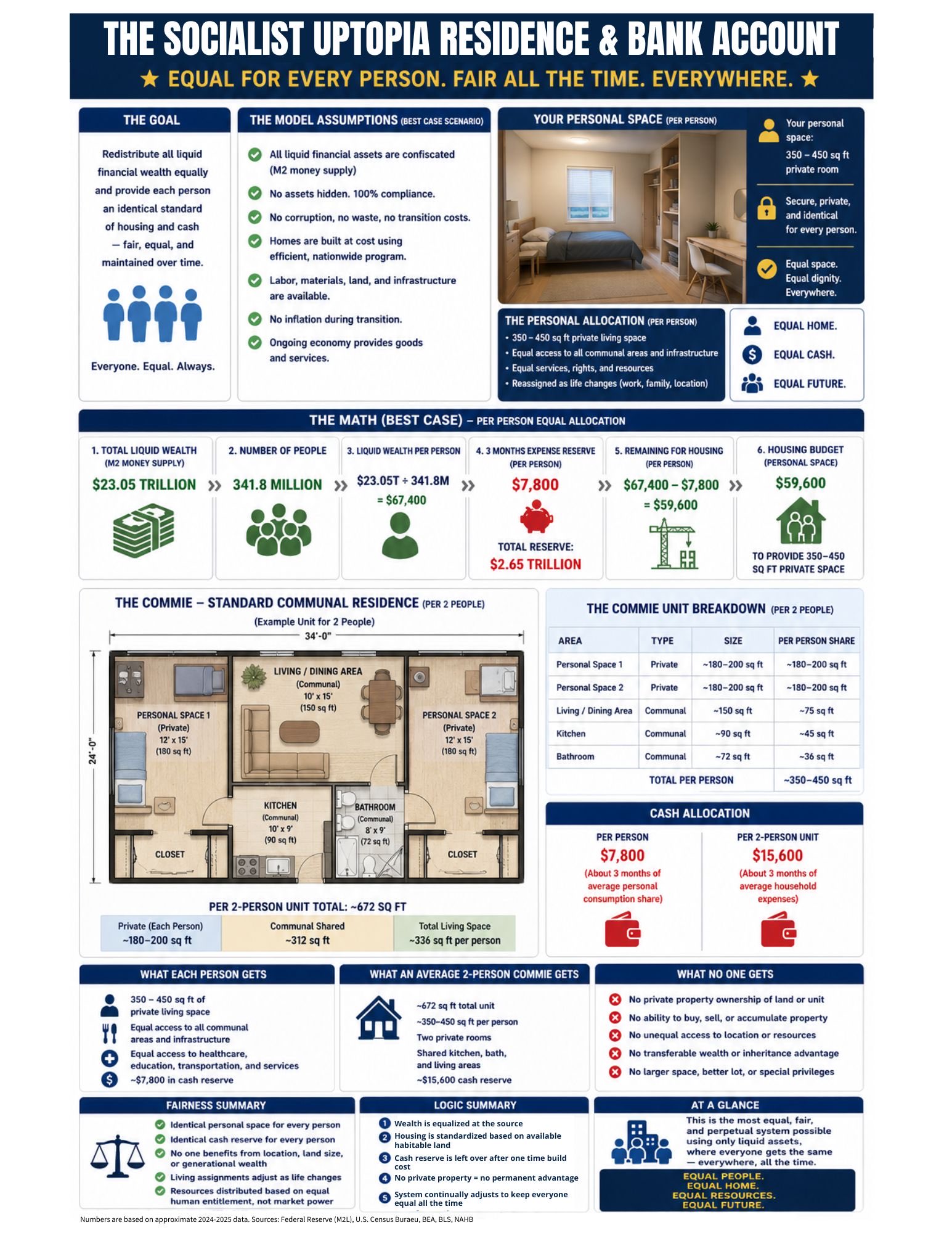
What does strict equal allocation look like under best-case assumptions?
Claim being tested
Completely redistributing liquid money would give each person only about five years of current social-welfare assistance equivalent. It would not make everyone wealthy; under strict equal distribution, it essentially makes everyone equally poor.
The five-year claim is the point of the model. If you divide the liquid money supply across the population, the per-person amount looks large for a moment but small compared with the ongoing cost of housing, food, medical care, education, and other social support. Using the current welfare-equivalent assumption in the tool, the one-time cash allocation is roughly five years of assistance, not a permanent new standard of living.